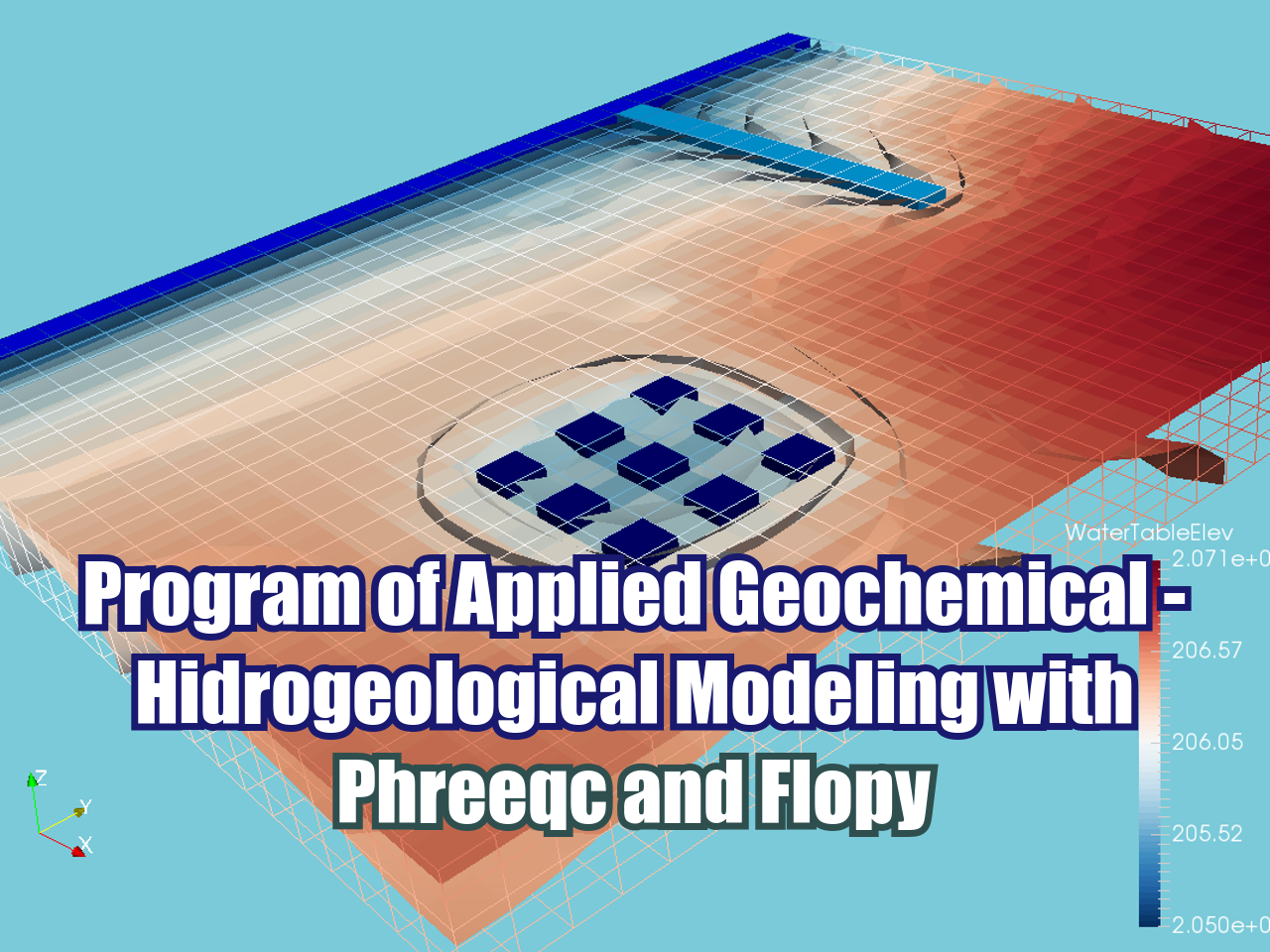
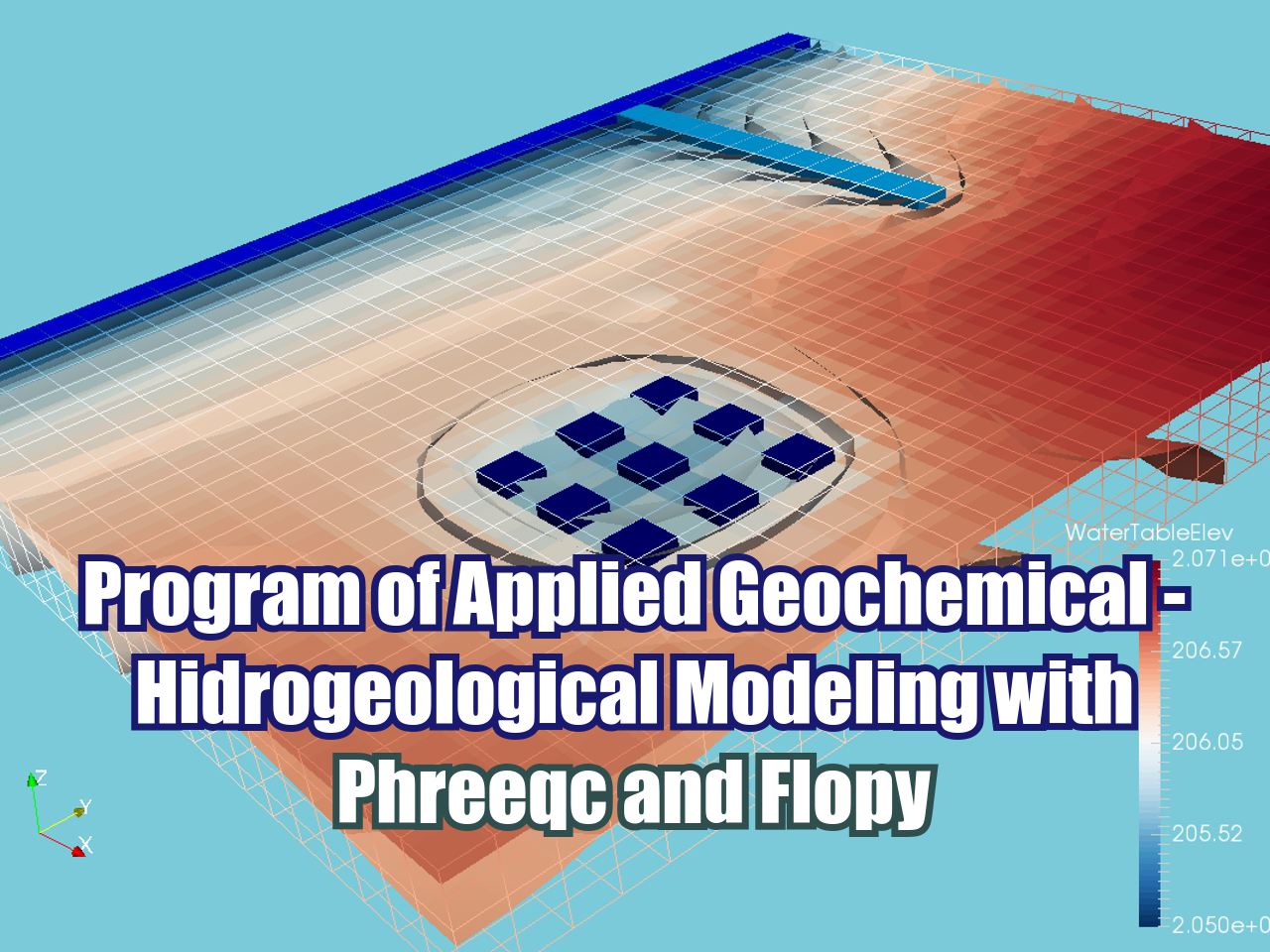
Hatarilabs presents the extension program based on 02 courses on Applied Geochemical Modeling with Phreeqc and Groundwater Flow Modeling with MODFLOW, Python and Flopy.
Phreeqc is a software developed by the USGS written in C++ capable of modeling a variety of aqueous geochemical processes such as mixing of waters, modeling equilibrium between solid and aqueous phase, modeling impact of temperature, calculation of species concentration among others. This course helps to run, parse and provide Phreeqc output as Pandas dataframes and integrate it to plots and further analysis with other Python libraries on a Jupyter notebook.
Flopy is the Python library that builds and executes MODFLOW models; this library has tools and options for the complete constructions of a MODFLOW model. Use of Python with the available scientific packages and FloPy, facilitates data exploration, evaluates different scenarios and performs model analyses that can be difficult to do with GUIs.
This program is developed in an asynchronous mode that allows students to follow the teaching materials at their most flexible schedule for 12 months.
Objectives
This program is designed to give you the following capabilities:
- Develop applied cases with Phreeqc and Python.
- Analyze Phreeqc results in graphics integrated with Python libraries in a Jupyter notebook.
- Know the Python and Flopy environment.
- Perform hydrogeological simulations in Python and Flopy.
- Analyze and spatially represent model information and output data.
Content
The program is divided into 02 modules. The content of each module and the
description of each session are described below:
Module 01: Applied Geochemical Modeling with Phreeqc and Python
Session 1: Speciation calculation
This example covers the simulation of the distribution of species in seawater and the saturation of a set of minerals. In order to demonstrate the capabilities of Phreeqc to simulate new elements, uranium is added to the solution by specifying keywords and with the use of the wateq4f database. The example covers all these cases:
- Speciate seawater specifying redox reactions.
- Speciate seawater with calculation of density and pe.
- Speciate seawater with uranium in the solution and defining phases.
- Speciate seawater with uranium using the Water4f database.
Session 2: Equilibrium with pure phases
This example covers the solubility of gypsum and anhydrite related to temperature. The Python code runs the Phreeqc example and parses solutions. Concentrations and saturation indexes are analyzed for the initial solution and a given batch reaction, however, for all the reactions a loop is performed to extract the Anhydrite and Gypsum saturation indexes of each reaction to plot the correlation of saturation indices with temperature.
Session 3: Groundwater and seawater mixing
Example that shows the Phreeqc capabilities to perform geochemical simulations in steps while each simulation takes the output solution from a previous one. This example shows the mixing of pure water in equilibrium with calcite and co2 that is mixed with seawater with standard concentrations of anions and cations.
Mixing is specified as percentages and the resulting solution is then equilibrated with calcite and dolomite. Carbon and calcium species and saturation indices for dolomite, gypsum and anhydrite are extracted from every simulation part and plotted as bar diagrams.
Session 4: Irreversible reactions
Applied example of Phreeqc for the simulation of irreversible reactions in the oxidation of pyrite. Pyrite, calcite, and goethite are allowed to dissolve in equilibrium and partial pressure of CO2 is maintained at 10E-3.5. Two species: 02 and NaCl are added into the solution in five different relative proportions of a given concentration. The geochemical simulation was carried out and results were compiled in pure Python and then compared with Phreeqc tools to export specific outputs.
Session 05: Exchange example
An example that demonstrates the Phreeqc capabilities to deal with sorption. This example uses the cation ion exchange approach where only the EXCHANGE keyword is used because EXCHANGE_MASTER_SPECIES and EXCHANGE_SPECIES are included in WATEQ4F.dat database. The model output is parsed as dataframes and the solution composition and description are calculated and compared before and after the exchange.
Session 06: Surface complexation
Phrreqc can model surface complexation and this example simulates the distribution of uranium species in acid mine water when it is treated with oxygen and limestone.The example has 3 simulations where each simulation uses the resulting solution from previous simulations. Concentration of the solution components and species for calcium, fe2+ and uranium are compared from the initial solution, in equilibrium with calcite and o2 and after the surface complexation. Only the SURFACE keyword is defined since the SURFACE_MASTER_SPECIES and SURFACE_SPECIES are located in the wateq4f database
Session 07: Reaction kinetics
Phreeqc uses the Kinetics keyword to specify kinetic reactions and parameters for batch-reaction and reactive-transport calculations. This example shows the use of reaction kinetics for the time dependent calcite dissolution where reaction rates are given by a small BASIC program. The example defines a Python function that lists the molarity and saturation of Calcite and plots those values for the different times defined as batch reactions.
Module 02: Applied Groundwater Flow Modeling with MODFLOW, Python and Flopy
Session 1: Introduction to Flopy
- Introduction to Flopy,
- Basic commands of Flopy
- Basic construction of steady state model with Flopy
- Graphical representation of model results with Flopy.
Session 2: Definition of time varying conditions
- Basic construction of a transient model with boundary conditions (WEL and RIV)
- Plotting hydraulic heads an flow directions.
- Varying conditions in a transient model.
- Insertion of the hydrogeologic parameters: Ss and Sy.
- Interactive representation of groundwater level
Session 3: Simulation of particle tracking and DISV grid
- Introduction to MODFLOW 6 in Flopy.
- Generate refinement with “DISV”
- Creation a particle tracking model.
- Simulation of particle tracking with MODPATH 7.
- Analyze particle tracking .
Session 4: Setting up of advanced packages and observations
- Implementation of Streamflow Routing (SFR) and Multiaquifer Well (MAW) packages.
- Coupling of multi-aquifer wells.
- Extraction of river levels by cells.
- Interrelation between wells and river.
Session 5: Implementation of triangular meshes and 3D anisotropy
- Use of Triangle library to generate grids in a model.
- Creation and representation of the active model domain with boundary conditions like Constant Head condition (CHD).
- Three-dimensional anisotropy with XT3D.
- Simulation of a flow model with triangular grids.
Session 6: Application of regional modeling
- Definition of spatial coordinate systems
- Insertion and intersection of shapefiles in the grid.
- Representation of hydraulic parameters.
- Definition of boundary conditions like recharge, evapotranpiration and drains.
- Coupling NWT to simulation
- Head distribution visualization at regional level
Trainer
Saul Montoya M.Sc.
Hydrogeologist - Numerical Modeler
Mr. Montoya is a Civil Engineer graduated from the Catholic University in Lima with postgraduate studies in Management and Engineering of Water Resources (WAREM Program) from Stuttgart University – Germany with mention in Groundwater Engineering and Hydroinformatics. Mr Montoya has a strong analytical capacity for the interpretation, conceptualization and modeling of the surface and underground water cycle and their interaction.
He is in charge of numerical modeling for contaminant transport and remediation systems of contaminated sites. Inside his hydrological and hydrogeological investigations Mr. Montoya has developed a holistic comprehension of the water cycle, understanding and quantifying the main hydrological dynamic process of precipitation, runoff, evaporation and recharge to the groundwater system.
Over the last 9 years Saul has developed 2 websites for knowledge sharing in water resources: www.gidahatari.com (Spanish) and www.hatarilabs.com (English) that have become relevant due to its applied tutorials on groundwater modeling, spatial analysis and computational fluid mechanics.
Methodology / Examination
Mode: Online - Asynchronous
Some details about the course methodology:
- Manuals and files for the exercises will be delivered on our online platform.
- The course will be developed by video streaming with life support and interaction, recorded videos will be available on our elearning platform.
- There is online support for questions regarding the exercises developed through email and webconferences.
- Video of the classes will be available for 12 months.
The exams are certification is organized as follows:
- The course has 1 exam.
- Digital certificate available at the end of the course upon the exam approval.