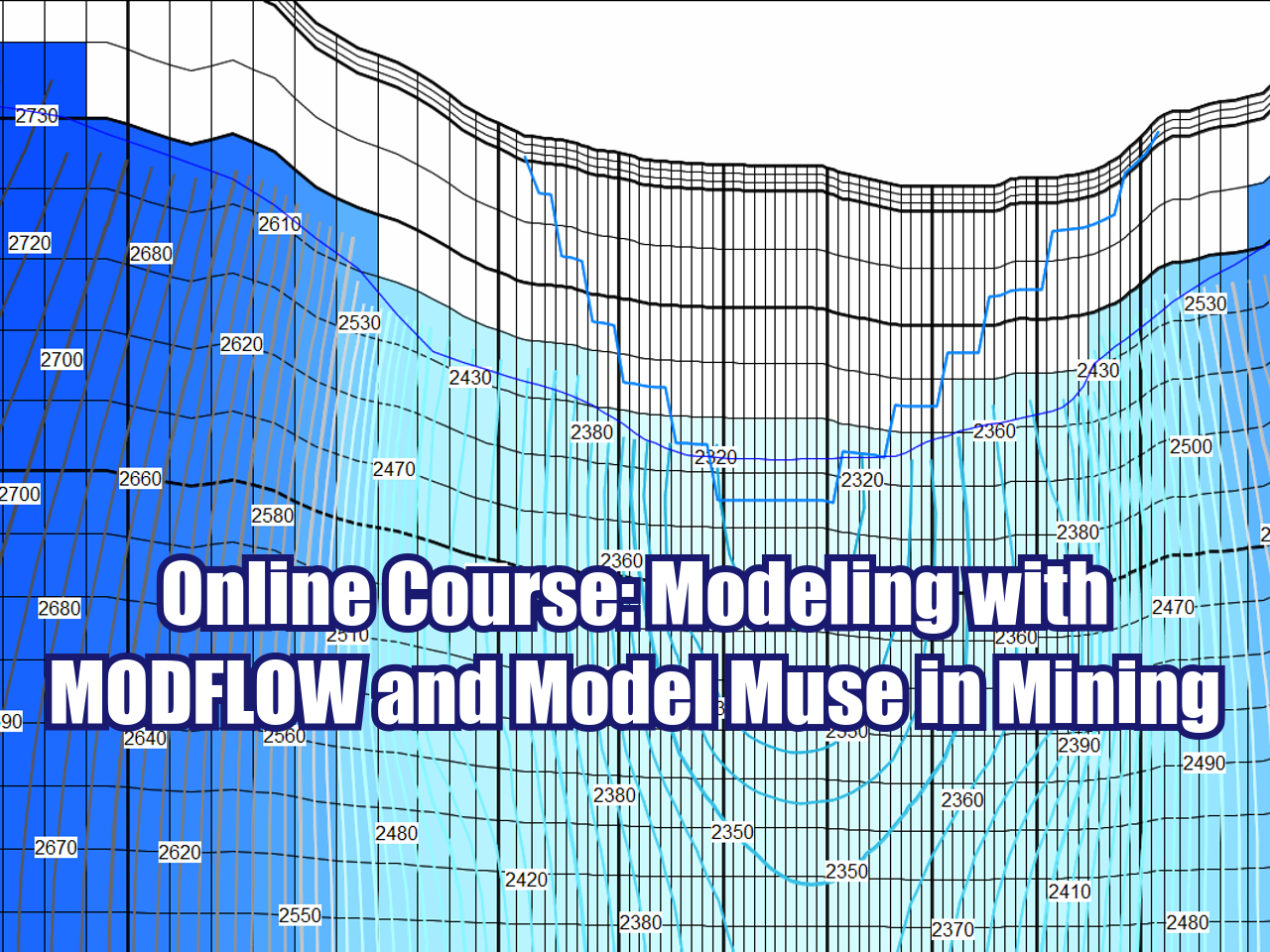
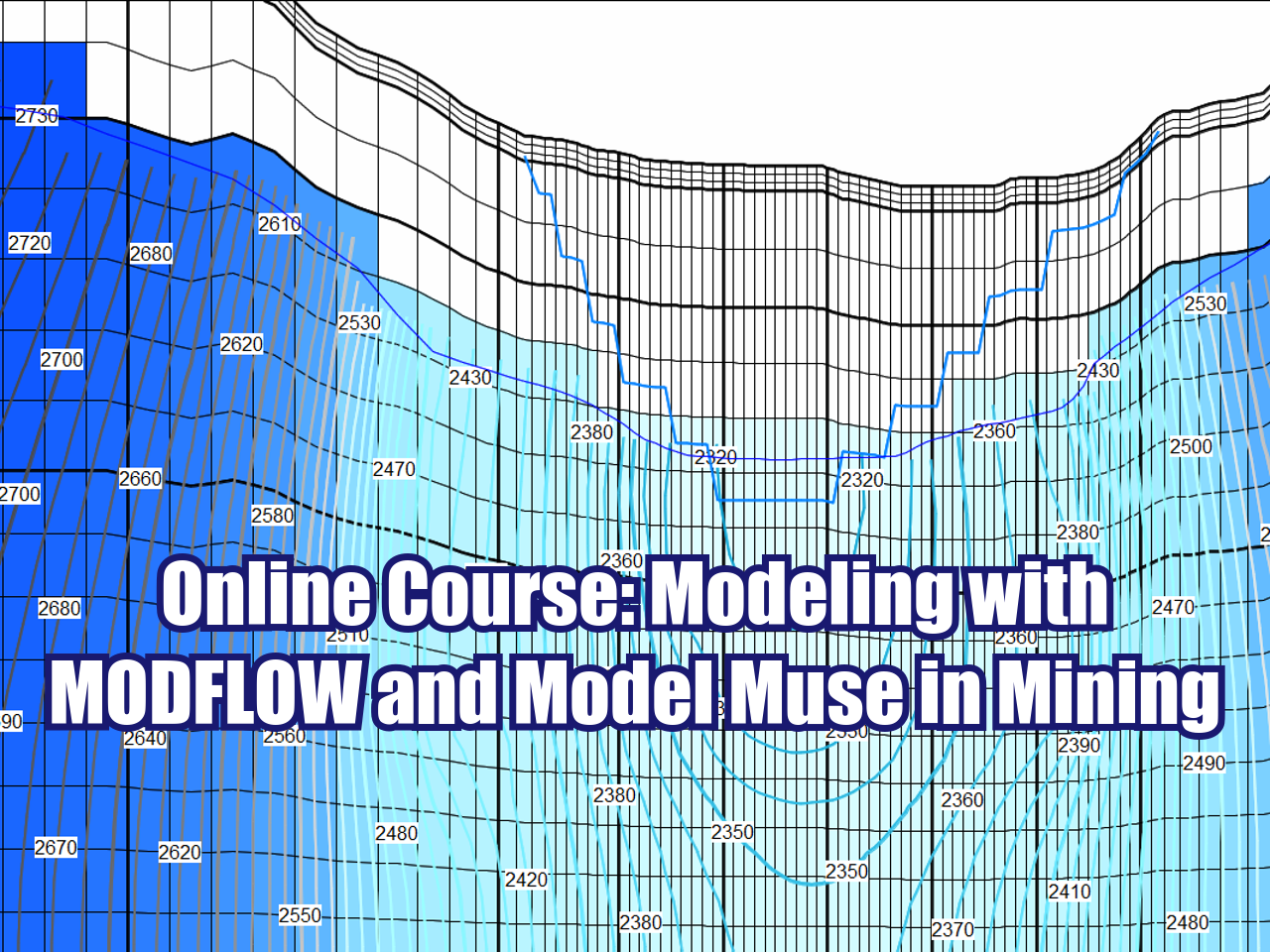
Modeling groundwater inflows to pit and underground mines and assessing the impact of mining projects on the surrounding groundwater flow regime is vital for the planning and engineering of mining projects. Mine working interaction with the groundwater flow regime is a dynamic process that the user can model with standard MODFLOW packages implemented on Model Muse. This platform has high performance due to its "design by objects" that optimizes the conceptualization of boundary conditions and other model elements, reducing construction time and improving the interpretation of output data. This course covers the use of MODFLOW with Model Muse for numerical modeling of the groundwater flow impact from pit development, underground mines and seepage from water dumps and tailings storage facilities.
Content
Session 01: Modeling underground mine inflows with MODFLOW
This session covers an applied numerical simulation of underground mine entrances covering transient model construction, simulation and water balance analysis. Several common steps in groundwater modeling are covered, such as importing vector and raster (elevation) spatial data, spatial and temporal discretization, setting hydraulic parameters, defining boundary conditions, running simulations, and exporting data. Here we will cover:
- Construct a model in a transient regime.
- Import vector data and elevations, refine the grid, discretize the aquifer, define space and times, and define boundary conditions.
- Define the water table.
- Assign hydraulic parameters, such as hydraulic conductivities of each layer.
- Simulate water inflow flows.
- Activate the ZONE BUDGET package
- Analyze the results with GW CHART
Session 02: Seepage flow modeling from mine dumps with Modflow and MT3DMS
This session covers the simulation of groundwater in the area of two mining
dumps in an Andean basin and visualization of the formation of the contaminant
plume. Here we will cover:
Define the aquifer and boundary conditions (Recharge, Evapotranspiration, Drains and Constant head).
- Import grid data for defining a water table.
- Import a dump mine area.
- Set up the MT3DM package to define the contaminant species.
- Analyze the contaminant plume in the time.
Session 03: Construction of a tailings dam model I
This session shows the insertion procedure of the boundary conditions and main properties in a tailing dam model on steady-state conditions over a five-layer model. The session includes:
- Importing vector data for defining the extension model, leachates zone and tailings areas.
- Importing elevations.
- Defining the aquifer.
- Setting up hydraulic parameters.
Session 04: Simulation of seepage flow from a tailings dam model I
This session covers the insertion of boundary conditions and simulation of the seepage flow from tailings on the model, using the Newton solver in Modflow. The session covers:
- Defining boundary conditions such as recharge, evapotranspiration and regional flow.
- Assigning and visualizing the hydraulic conductivity in the tailing area.
- Setting up the properties of the NWT solver.
- Visualizing of the water table
- Analyzing of results
Session 05: Construction of the drainage pit model II
This session covers the construction of the pit drainage model that includes analyzing the spatial discretization, the temporal discretization, the definition of type confinement and analysis of the water table. Here we will cover:
- Insert grid refinements.
- Set up steady and transient temporal discretization.
- Define the types of boundary conditions required and their application by objects.
- Configure hydraulic parameters of the aquifers.
- Visualize the water table using the triangle method interpolation.
Session 06: Simulation of drainage pit model II
This session focuses on evaluating the hydrogeological regime according to the pit's progress throughout the mine's life. Here we will
- Import elevations according to the mine plan.
- Simulate the transient model in MODFLOW for pit drainage.
- Analyze the water table throughout the life of the mine.
- Perform detailed water balances and determine the cone of depression.
Trainer
Saul Montoya M.Sc.
Hydrogeologist - Numerical Modeler
Mr. Montoya is a Civil Engineer graduated from the Catholic University in Lima with postgraduate studies in Management and Engineering of Water Resources (WAREM Program) from Stuttgart University – Germany with mention in Groundwater Engineering and Hydroinformatics. Mr Montoya has a strong analytical capacity for the interpretation, conceptualization and modeling of the surface and underground water cycle and their interaction.
He is in charge of numerical modeling for contaminant transport and remediation systems of contaminated sites. Inside his hydrological and hydrogeological investigations Mr. Montoya has developed a holistic comprehension of the water cycle, understanding and quantifying the main hydrological dynamic process of precipitation, runoff, evaporation and recharge to the groundwater system.
Over the last 9 years Saul has developed 2 websites for knowledge sharing in water resources: www.gidahatari.com (Spanish) and www.hatarilabs.com (English) that have become relevant due to its applied tutorials on groundwater modeling, spatial analysis and computational fluid mechanics.
Methodology / Examination
Mode: Online - Asynchronous
- Some details about the course methodology:
- Manuals and files for the exercises will be delivered on our online platform.
- The course will be developed by video streaming with life support and interaction, recorded videos will be available on our elearning platform.
- There is online support for questions regarding the exercises developed through email and webconferences.
- Video of the classes will be available for 12 months.
The exams are certification is organized as follows:
- The course has 1 exam.
- Digital certificate available at the end of the course upon the exam approval.